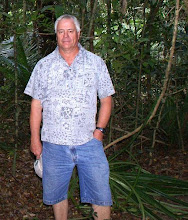
Happy birthday to my wife. Last night, we went out and had nice buffet dinner. In Cajun country on a Friday evening, especially during Lent, this means all-you-can-eat seafood. I especially enjoyed the boiled shrimp. The shrimp are hugh down here. Judy got some nice birthday cards and several phone calls from family and friends.
Tomorrow is Lori's birthday. Happy birthday to Lori as well!
I spent the better part of the day planting our garden. The only thing that we have in the garden that carries over is three rows of potatoes planted in early February that are just about ready to flower. Everything else was cleaned out to make room for today's planting. Today, I planted beans, cowpeas, corn, tomatoes, peppers, and spinach. Later on, I will transplant a few vine plants, like watermelon, canteloupe, cucumbers, and squash. It's a bit risky to plant them right now. Judy ordered some edamame soybeans that we are going to try for the first time. Soybeans are supposed to be pretty healthy, and the edible ones are quite tasty. We'll see what happens and report.
Saturday, March 7, 2009

Saturday, February 28, 2009
Back from North Carolina
 I went to the SAS Institute to learn more about SAS programming, and statistical applications relevant to the type of research I am involved in. It was a whirlwind trip, but, on the whole, well worth the experience for me. Compared to other class members, it became quickly obvious that I was at a huge disadvantage in knowing almost nothing about programming in SAS. My only saving grace was that I have had a lot of statistical training in graduate school many moons ago, back when we had to do all of our calculations by hand, which meant that we really had to know our stuff.
On the programming side, my experience was something like walking in to a second year language course without having taken the first year course. I winged it the best I could, but when we did the exercizes, even though I knew what was going on from the statistical side, I was hopeless in trying to plug in the proper commands, because I was completely unfamiliar with the syntax. The teacher let me go to the answer pages, and type out the answers, with the hope that I could get something from the experience of typing out the commands. I was strongly encouraged to come back and take their Programming I course. Fat chance that will ever happen. However, there is a remote chance that I will be supported in doing some self-tutoring on line.
During the training, I was intrigued by how much homage was paid to the one of the original founders and current CEO of SAS, Jim Goodnight, who is generally regarded as the wealthiest man in North Carolina. It sort of reminded me of when I worked at Walmart...all the stuff we learned about Sam Walton. Apparently, SAS is one of those rare companies that has made a point of taking care of its employees through the years, and this has paid off handsomely for the company. I asked how their company was coping with the economic downturn, because financial institutions are among their bread-and-butter clients. They apparently made the decision to put everyone's salary on hold for the time being, as opposed to laying anyone off. Nobody was complaining. They are all glad to have their jobs. The campus (Training center: Bldg F) is large and very attractive, nestled in the pines. Cary, NC has grown enormously and now exceeds 120,000 in population...and being the bedroom community that it is for the Raleigh/Durham area, doesn't even have a downtown...so I was told. The percent of people living there that have advanced degrees is probably as high as any location of its size in the U.S. All in all, I was quite happy to have had the experience, and the greater exposure to SAS and what it has to offer in the way of statistical packages.
Monday, February 23, 2009
Mardi Gras Live!
 Today is Lundi Gras and Mardi Gras is only hours away. The weekend was filled with parades in New Orleans and surrounding communities. The party atmosphere really goes into overdrive from here on until midnight tomorrow night. While there are numerous dedicated Mardi Gras websites, Bourbon Street web cams, etc., my personal recommendation would be to go to WDSU TV. It's live and the crew following the various parades do an excellent job. You can watch live, or sample some of the videos at the bottom of the webpage to get a sense of what Mardi Gras offers those who flock here to see the spectacle.
I'm heading out of town tomorrow...going to Cary, North Carolina...to brush up on the statistical packages that SAS has to offer. Training isn't cheap, but the statistician at our area office had built up some extra credit, so she is allowing me to take advantage of the credit she had built up, which I am very grateful for. Timing is good, to get away from the craziness, but Judy is going to have to drive me to the New Orleans Airport, since it's pretty much a given that there won't be any parking spaces available.
Saturday, February 21, 2009
Utah Jazz owner Larry H. Miller: 1944-2009
 One of the most generous and extraordinary men Utah has ever produced, has fallen at the not-so-old age of 64, at least not old from my perspective. Quoting from a Deseret News write-up on Miller, "Miller's rags-to-riches story is a chapter out of Horatio Alger. A poor high school student and a college dropout, he started his professional career as a stock boy in an auto parts store and, through the sheer force of his personality, work ethic and natural intelligence, became one of the most successful entrepreneurs in Utah history, and one of its most prominent residents. He graduated from SLC's West High School with a 1.77 GPA, and lasted six weeks at the University of Utah before dropping out. He worked a series of odd jobs for a time before he found his place in car-related businesses. In 1970, he moved to Colorado, where he became a parts manager and eventually general manager for car dealerships in the Denver area. During a vacation visit to Salt Lake City in 1979, he passed a dull afternoon by visiting an old acquaintance in the car business. By the end of the day, he owned his first dealership, purchasing a Toyota store from his acquaintance after writing up terms of the deal on a blank check. Miller not only became the 10th largest car dealer in the nation, with 42 dealerships in six states, but he also began acquiring other businesses in the coming years. The Larry H. Miller Group eventually included 74 business enterprises — movie theaters, auto dealerships, a world-class race track, a movie production company, an advertising agency, ranches, restaurants, TV and radio stations, a real estate development company, an NBA franchise, a professional baseball team, an NBA arena, a motorsports park, sports apparel stores and various philanthropic organizations. At one time they produced $3.2 billion in sales annually."
His association with the Utah Jazz is equally extraordinary, and well worth reading. I recommend going through the entire Deseret News article written by Doug Robinson. It's four web pages long. While we lived in Utah, Miller frequently made the news. I thought his storied life was most fascinating. The man had a reputation for getting very passionate and emotional about issues. It was obvious that he had a heart of gold inside of him. Many benefited from his generousity, adherence to higher principles, and willingness to take enormous business risks that most of us would never have considered taking. He had one of those rare personalities that made him stand apart from the average entrepreneur. I couldn't help but admire him. Here is the sports video associated with his passing.
Monday, February 16, 2009
A Sunday in the New Orleans Garden District
 On Sunday, I was invited to speak in the New Orleans 1st Branch. As background information, when a congregation is too small to fully function as a ward, then a branch is formed. The ecclesiastical leader of a Branch is referred to as a Branch President, rather than a Bishop. So we are talking about a small unit. The members worshipping in the New Orleans 1st Branch live in the uptown New Orleans area. They include students and teachers attending Tulane and Loyola Universities nearby. The chapel (also referred to as the uptown chapel) is located in the famed Garden District of New Orleans at 3616 St. Charles Avenue. You can actually see what the chapel looks like on Google Maps Street View. At or near the above address, it's the red brick building with the plain steeple as you point north .
On my speaking assignment, I invited Bro. DiMaggio to come with me. Bro. DiMaggio is an older member who has a wonderful self-effacing sense of humor, and is a delight to be with as a travelling companion. We spoke on the 6th Article of Faith having to do with church organization (similarity to the church that Christ organized while He was on the earth), and discussed the priesthood offices in the church including apostles and prophets, all the way down to the young deacons (12-13) and teachers (14-15) who passed the sacrament to the congregation. I was not too surprised to learn that about half of the congregation was made up of out-of-town visitors. Apparently, this is not too uncommon. It reminded me of our first church experience in Hawaii in the Waikiki Ward, and our experience attending the Hyde Park Ward in London. The vast majority of church members who live in the New Orleans area, are in the suburbs, especially Metairie, Kenner, and the West Bank of the Mississippi River. Within the New Orleans Stake, our Thibodaux Ward is the furthest away from New Orleans, and the more affluent Covington Ward on the North Shore of Lake Ponchartrain is the largest, certainly in active priesthood attendance.
 While many associate New Orleans with Mardi Gras and the French Quarter, New Orleans has so much more to offer. Whenever we take visitors to New Orleans, we try to make a special point of taking them on St. Charles Avenue so that they get some exposure to the architecturally delightful Garden District, especially at the end of St. Charles Avenue where Audubon Park and Zoo are located. The French Quarter is a whole different experience, and has much to offer. It is like a city within a city, sort of like some of the old European cities that have a old fortified city area that is surrounded by the modern city. The best part of the French Quarter, in my view, is NOT Bourbon Street, which way too commercialized for my taste. I much prefer walking from Jackson Square down some of the other French Quarter streets like down Chartres St., returning on Royal St., taking in a few perpendicular avenues, and avoiding Bourbon Street altogether. I guess you have to do a little bit of Bourbon Street, just so you can say that you did.
After the three-hour church block, we couldn't get onto St. Charles Avenue because of a Mardi Gras parade. So we ended up taking a back street to get out. Mardi Gras parades will be coming at us fast and furious until Mardi Gras (Fat Tuesday) next week.
Thursday, February 12, 2009
Onions, shallots, and the leek in Louisiana

I admit, "onions, shallots, and the leek" isn't even as punny as "Allium in the family." We have tried growing onions, shallots, and leek, all members of the Allium genus in our garden, and have had good success growing them in the winter. Judy just recently harvested both onions and shallots, which we planted in early October (pictures are of the shallots we just harvested).
 Judy prepared a large quantity of shallots, cut them up, and put them in our dehydrator, so we were able to store a substantial supply to flavor our dishes for a considerable time. Onions, shallots, leek, garlic, and chives are all used extensively in Cajun cooking. Both the ability to easily grow these particular Allium species in this area, and their popularity with the French generally, helps explain why they are so extensively used down here. Among the big three, leek was our least favorite.
I read at one website that it would be more accurate to refer to shallots as a type of onion than a distinct species. Shallots could be thought of as a more mild form of onion. Unlike onions, the bulbs grow in clusters, the individual bulbs being more flattened than are onions, which are generally pretty much always round at the base.
Monday, February 2, 2009
Kayaking on the Falgout Canal
 Extending from the Intracoastal Waterway that intersects Houma, four major bayous meander southward to the Gulf Coast like four extended fingers on a hand. They include from West to East, Bayou du Large going through the town of Theriot (tier-ee-oh), Bayou Grand Caillou (Kie-you) going through Dulac, Bayou Petit Caillou going through Chauvin and eventually Cocodrie at the end of the Hwy 56, and Bayou Terrebonne going through Montegut.
 On Saturday, I took the 18 mile drive from our home down Bayou du Large through Theriot all the way to the Falgout (Fal-goo) Marina where I launched my kayak. I paddled my kayak the full distance of the Falgout Canal and back (3.6 mi. x 2 = 7.2 mi.). It took about 2 hours.
 There is a highway that goes along the south side of the canal. At the far end of the Canal, I got out, crossed the highway and took a picture of what has been described as a "cypress tree graveyard," an area that is transitioning from fresh water swamp land to brackish marsh land.
 The loss of land in southern Louisiana is of great concern to Louisianans, and should be to the Nation as a whole.
The yellow arrows in the Google Earth photo show beginning and ending points of my trip, and the yellow dot is where I took a picture of the dead cypress trees.
Subscribe to:
Posts (Atom)