Katie Bodily, a ward member who is moving back to Utah soon, had a video camera at the event and took some footage that she posted at her blogsite. It is
Sunday, April 20, 2008
Crawfish boil with BYU-Idaho group
Great f
ood. Great music. Great time together.
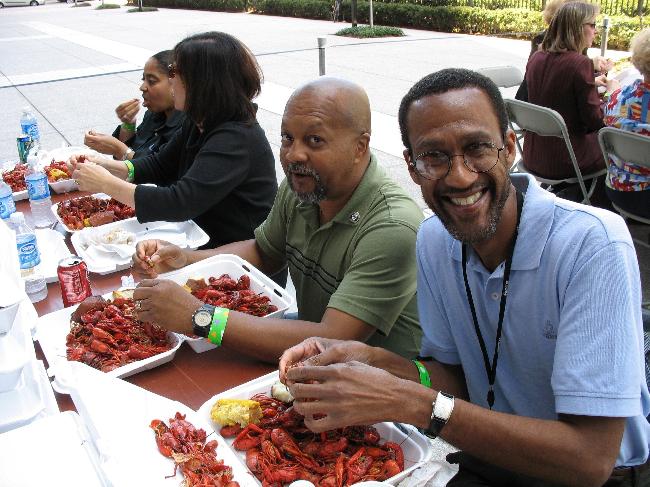
Katie Bodily, a ward member who is moving back to Utah soon, had a video camera at the event and took some footage that she posted at her blogsite. It is
n't high quality, but it's ok. She posted the stills and videos the day of the Thibodaux Ward Crawfish Boil, on April 19, 2008. We had about 50 students from BYU-Idaho. They had a blast. I'm posting some of the better pics I took. Mine were either too light or too dark, because I didn't know what I was doing. Judy did her best to make them respectable, afterward.


Katie Bodily, a ward member who is moving back to Utah soon, had a video camera at the event and took some footage that she posted at her blogsite. It is
Tuesday, April 15, 2008
Raising cane in Louisiana
Sometimes when people ask me what I have done for a living, I tell them I started earning enough money to live on as a graduate assistant breeding a better malting barley for the beer industry, then I moved on to "raising cane," and on the side "growing grass." Hmmm...maybe a little explanation is then in order.
Here's a video we show at our research station. It's a bit dated, since the harvesting system has largely changed from soldier harvesters that lay whole stalks in a heap row, to a combine harvester that cuts the cane into 8" pieces, and drops them directly into a wagon that travels alongside the harvester. The video, as seen online, is in two segments, Raising cane in Louisiana - Part 1, and Part 2. Enjoy, if you have the interest. It lasts about 12 minutes in total.
Monday, April 14, 2008
Sugarcane bagasse turned into Hallmark cards
Bagasse has many uses. Bagasse is the primary fuel source at most sugarcane mills. It produces enough heat energy to supply the needs of the mill, and, in some cases, electricity is sold to the public, such as at Florida Crystals’ Okeelanta Cogeneration Plant. It has been used in the building industry as an ingredient in particle board, acoustic tiles, etc. With molasses added, it has also been used as a bulking agent in animal feed. It has also been used as an ingredient in compost for landscaping. While living in Hawaii, I used it as a compost ingredient when I was commercially growing "organic" turfgrass sod on black plastic. Enter the keywords "bagasse biodegradable" into a search engine and you'll be amazed at the range of products that can be purchased that are made out of bagasse.
Sunday, April 13, 2008
BYU-Idaho Symphony Band performing in Louisiana
Tomorrow night on the 14th, the BYU-Idaho Symphony Band will be performing in our back yard, at Nicholls State University in Thibodaux, about 30 minutes drive north of Houma. They will also be performing in Baton Rouge and New Orleans, during their tour. How did they end up coming to Thibodaux? Maybe it had something to do with the fact that their director, Diane Soelberg, was a former member of our ward in the 1980's. I was told at church today that she was sorely missed when she left, because of her piano playing skills. It so happens that Thibodaux Ward's annual crawfish boil will be this coming Saturday, the same day that the band members are scheduled to perform in New Orleans. They have accepted our invitation to participate, so we will have approximately 50 additional people at our crawfish boil this year. I can't wait to see them rolling up their sleeves and tackling a heaping plate of crawfish (generic link to get the idea). I'll be sure to send some pictures of the experience. A cajun band will be providing live music for all to enjoy, so the symphony members will get the whole cajun experience. It should be fun!
Saturday, April 12, 2008
The biofuels debate
An increasing number of articles have recently been critical of biofuels. Two that reached wide audiences are in National Geographic and Time. Both were highly critical of corn-based ethanol in the U. S., but viewed sugarcane-based ethanol in Brazil in a much more positive light. Corn is criticized because, as a major food and feed crop, diversion of the grain toward the production of ethanol has the effect of driving up food prices. Also, the energy balance (output to input ratio) is not that attractive (Nat’l Geog.: 1.3 to 1.0). By contrast, the energy balance for sugarcane, at least in Brazil, was cited as 8 to 1. This begs the question as to why sugarcane is not used for ethanol production in the U.S. If the energy balance for sugarcane were only half as good as in Brazil (4 to 1) this is still much better than for corn. If the energetics really do favor sugarcane, why can ethanol be profitably made from corn, but not from sugarcane? I put together some numbers, based on what I found on the Internet, to compare the sugarcane situation in Brazil and the U.S.
Monday, April 7, 2008
Another connection
The name, Tew, originates from England. My great grandfather, Thomas Tew, Jr., was the first of my direct Tew line to arrive in the U.S. The family of Thomas Tew, Sr. investigated the LDS (Mormon) Church. As teenagers and now converts to a new religion, both Thomas Tew, Jr. and his close friend Walter Bird, were sent to Utah ahead of their respective families. They were given enough money to buy steerage passage on a ship from England that arrived at the Port of New Orleans in 1850. From there, they went up the Mississippi River to St. Louis. They got work driving ox teams to the west. At the time, they knew nothing about oxen, or how to set ox bows on them to team them up to pull wagons. Obviously, over the next several weeks, they became well acquainted with oxen. They fared pretty well until they got into mountainous country, where Thomas came down with Rocky Mountain spotted fever. He became completely helpless. The wagon master told the group to leave Thomas behind for dead, but Walter sneaked his lifeless-looking body into a wagon, covering him up, and he eventually revived. Thomas owed his life to Walter. Shortly after their arrival in Salt Lake City, they were sent 50 miles south into the Utah Valley where they settled in what is now the Springville-Mapleton area. Their respective families soon followed. Thomas eventually married Walter’s sister, Rebecca Bird. As the best of friends for life, it is fitting that Walter and Thomas were buried next to each other in the Evergreen Cemetery that borders Springville and Mapleton. And now, 140 years later, the name, Thomas Tew, has come full circle, with myself returning to within an hour’s drive of the N
ew Orleans and the Mississippi River. Every time I fly from N.O. to S.L.C., I can’t help but think about the stark contrast between my short flight and the arduous journey taken by my great grandfather. Picture taken in the late 1800's, is of Thomas Tew, Jr. (sitting, 1833-1904), with his sons, John Henry (center, 1868-1948) and my grandfather William Thomas (right, 1859-1933).
ew Orleans and the Mississippi River. Every time I fly from N.O. to S.L.C., I can’t help but think about the stark contrast between my short flight and the arduous journey taken by my great grandfather. Picture taken in the late 1800's, is of Thomas Tew, Jr. (sitting, 1833-1904), with his sons, John Henry (center, 1868-1948) and my grandfather William Thomas (right, 1859-1933).Sunday, April 6, 2008
French Connection
To live in southern Louisiana is to be immersed in French culture. As in Hawaii, where the locals sprinkle their everyday vocabulary with Hawaiian words, Louisiana has a strong french connection, and their everyday conversations strongly reflect this. Counties are called parishes. It isn't unusual to hear people refer to the size of their property in arpents instead of acres. Specific laws also reflect Louisiana's French roots. For example, the principle of "forced heirship"—that a child is legally guaranteed a share of his parents' estate—comes from the Napoleonic Code and does not appear on the books in any of the 49 common-law states. Similarly, some laws governing commercial transactions in Louisiana come from the French system, putting them at odds with the parts of the Uniform Commercial Code used by other states.
My french connection, albeit weak, is my middle name, LeRoy (the king), which I can trace back through my mother (maiden name, Mary LeRoy), through three additional generations, Ammon Alexander LeRoy (GF), Daniel Vestor LeRoy (GGF), and Louis Roy (GGGF), who settled in Missouri presumably (though not positively verified) from Quebec, Canada.
Subscribe to:
Posts (Atom)