Showing posts with label gardening. Show all posts

Monday, October 4, 2010

Sweet potatoes harvested and fall garden planted


With almost no work, except for the digging at the end, we harvested a wheelbarrow load of sweet potatoes this year...getting an even bigger harvest than last year.  We don't even know what to do with them, except to give a good portion of them away .


This past weekend we planted our annual fall-winter garden which includes carrots, radishes, broccoli, cauliflower*, cabbage*, loose-leaf lettuce*, head lettuce*, beets, swiss chard, bush beans, spinach, and onions*.  Starred (*) veggies were transplanted.  The bush beans are experimental for us this year as a winter crop.  The rest are veggies that I know first-hand will thrive in southern Louisiana's fall and winter.  I would like to think that this will be the last garden crop I will plant in Louisiana, but I'm not betting very heavily on it.

Thursday, August 5, 2010

Sweet potato variety 'Evangeline'

This is the second year that we have let 'Evangeline,' a sweet potato variety developed at Louisiana State University, essentially take over our garden during the hot summer months.  Actually, I don't mind having a garden crop that essentially does its own thing with very little effort on my part.  It literally filled up the garden from two little plants that survived through the extra cold winter we had.  Evangeline is quite attractive, with its unusual purple pigmented leaves, and colorful flowers.  It is also sweeter than earlier bred sweet potato varieties.  Sweet potato is related to the infamous morning glory weed, so it is not surprising that it has the ability to cover such a large ground area in a short time.  In late September, we expect to dig out another bumper crop of sweet potatoes.  This is about as good a garden crop as there is from the perspective of minimum input and maximum output.  The variety name, Evangeline, hearkens back to the poem by the same name, written by Henry Wadsworth Longfellow, and has a special connection to Louisiana, as explained in the Wikipedia article about the poem.

In the upper picture, you might have noticed that I have a row of beans, actually edible soybeans on the right side of the garden which the sweet potato vines are beginning to take over.  I will probably get my cane knife out, sharpen it, and do a quick slash cut down the row between the sweet potatoes and the soybeans.  I may have to do this a couple more times until the soybeans are mature enough to eat.  I wish I had planted a few more soybeans, now that I know they can be productive in Louisiana's intense summer heat.

Saturday, June 5, 2010

Vegetable Day at the USDA Sugarcane Research Facility


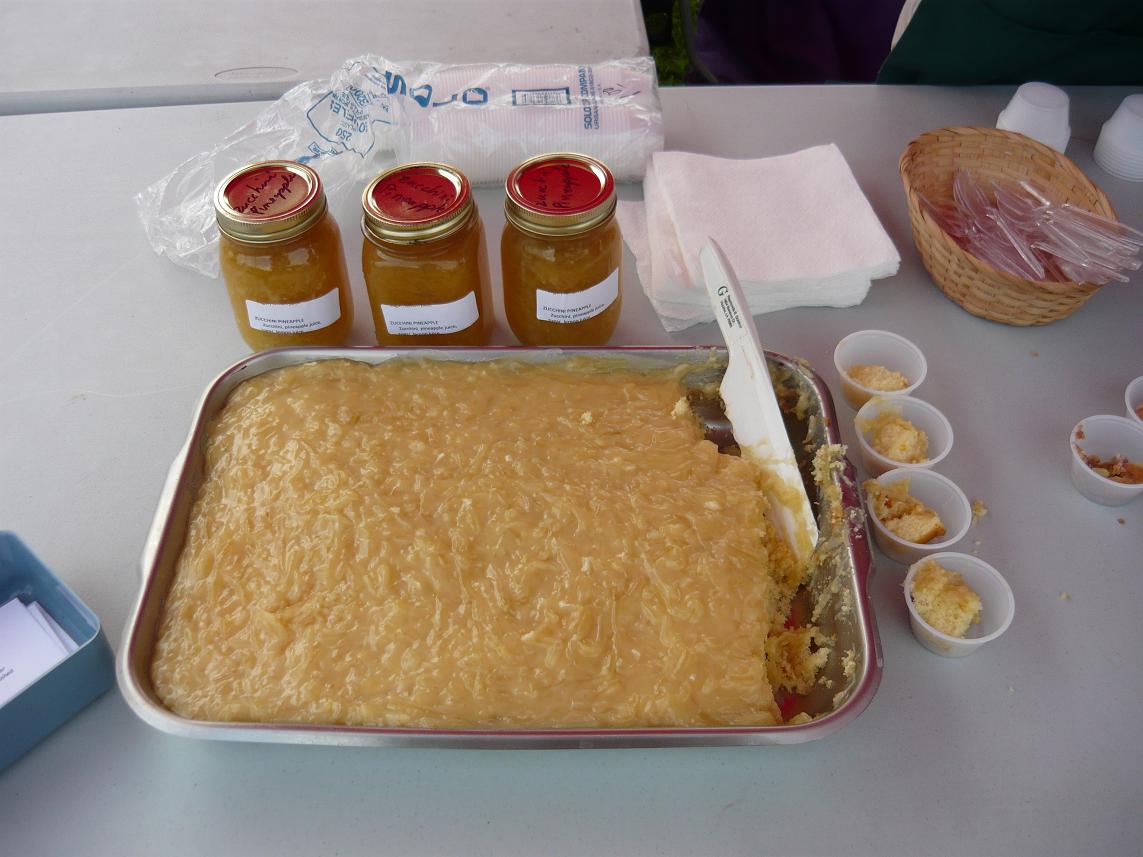
This is the second straight year that the Master Gardeners in our region and the LSU Extension Service have chosen to grow their display garden at our facility.  We are ideally located for this.  The Southern belles who attended, prepared some wonderful dishes that included 1) grilled vegetables seasoned with low-sodium taco seasoning and olive oil, 2) green tomato pie, and 3) pineapple zucchini cake.  Master gardeners, LSU extension service personnel, and our own Eric Pitre, a senior technician at our Station who lives on site across from where the garden was planted, gave some terrific presentations.  I was very impressed, and learned a lot.  Dr. Paul White, a recently hired scientist at our Station, won the largest tomato contest with a 24+ oz. tomato.  Good job, Paul!

Wednesday, March 24, 2010

Spring garden is in

While some of the country is still having winter weather, snow and all, it is pleasant enough down here in southern Louisiana to risk getting an early start on a spring garden. I took Friday off last week to get the garden in, knowing that Judy and I would be at the temple in Baton Rouge on Saturday. This year, the main changes I made were to 1) plant a few eggplants that were given to me, 2) do my own indoor planting of tomatoes rather than buying transplants, 3) try bush beans instead of edible soybeans with the thought of planting soybeans in early summer. The rows are labeled if you click on the picture. The reason the potatoes are already up is that I planted them in mid-February. The cucurbits this year will include watermelon, cantaloupe, cucumbers, and zucchini squash. They spill over from the last row into the grassy area. We also planted a row of peas on the far side of the fence on the right side and will let them climb up the fence. All of you that live further north can appreciate that an early garden is one of the perks of living in the deep south.

Tuesday, January 12, 2010

Freezing on the Bayou

Finally, we are getting relief from the freezing weather down here in southern Louisiana. I have lived in this area for just over 10 years, and this is without question the coldest week I have encountered since moving here. In the last eight days, we have been significantly below freezing at night, as cold as 22 degrees (F) early Sunday morning (January 10). I was amazed at the number of schools that have shut down around this area because of the cold temperatures. I suppose this has as much to do with bursting frozen pipes as anything else.

All of the sugarcane froze above ground, so at work, we finally have an opportunity to really take advantage of a sugarcane freeze test that we install annually. On Thursday, Jan 7, we cut stalks out of every plot in a fully replicated test that has all of the important varieties that our industry either currently relies on or will shortly be planting in their fields. For the next several weeks, until there is no further change in deterioration, we will be repeatedly re-sampling this test. The expectation is that the freeze this year will have been extreme enough (hopefully, not too extreme) to show which varieties are the most freeze tolerant and the least freeze tolerant. Those that are the most freeze tolerant will obviously tend to be left in the field the longest during future harvest seasons. Thankfully, much of the cane has already been harvested this season, and many of the mills have already shut down. What is interesting is that even though the cane stalks may freeze and thus be subject to rapid deterioration, especially the more sensitive varieties, not very much deterioration will occur until the cane in the field is significantly above normal refrigeration temperatures, so I think our farmers, for the most part, dodged the bullet this year, at least as far as harvesting goes. There is some question as to whether the below-ground temperatures got cold enough in places as far north as Bunkie and New Roads to severely affect stubble crops, as they did in 1989.

Our garden, and many of our more temperature sensitive plants around our home got whacked pretty hard. We probably lost some of our weaker citrus trees. A guava tree we planted next to the road last year looks pretty miserable as well. I have heard that in Florida, where several cold temperature records were set, iguanas are falling out of trees, and the pythons have become an easy catch for those trying to reduce their numbers. Since I don't care for either one, this is welcome news.

Saturday, October 24, 2009

Garden update

Our fall garden is underway with the planting of cauliflower, broccoli, cabbage, onions, and a new entry...bok choy. The bok choy grew so fast that Judy picked some stems tonight and so we will be trying it out for the first time. Judy was looking at some recipes today. I can't wait to see how the bok choy tastes, since I have never tried it before.

Just for an update on our summer garden, we planted a few slips of a very colorful variety of sweet potato, bred at LSU, called Evangeline. It has a mix of purple and green leaves. I put it in the garden in early summer after we had harvested most of the spring-planted crops, and it pretty much took over the garden with very little care. It was pretty much growing wild. To our surprise, we got a bumper crop of sweet potatoes, which is amazing considering that we only planted a few slips to begin with. Judy made some pies with the sweet potatoes; the people at work swore they had to be pumpkin pies when I let them get a taste. When it came time to establish a fall garden, we knew we were going to see unwanted sweet potato plants sprouting up like weeds, but it turns out that it wasn't too much of a problem. I guess the sweet potato is related to the morning glory which helps to explain its aggressiveness.

We had some cantaloupe and watermelon plants that hung in there longer than we expected ... another pleasant surprise. Our satsuma orchard consisting of three small trees also had an amazing number of satsumas (a type of Mandarin orange originating from China but brought here from Japan). We have been enjoying them over the past month. Today, Judy harvested two small pail fulls, which will be turned into "orange" juice. I must say that our garden and back yard have surprised us by how productive they have been over the past year.

Saturday, October 17, 2009

New Orleans City Park

Wow, I can't believe it has been so long since I last visited my own blog site. We were at the end of the USDA fiscal year which goes from October 1 through September 31 each year, so there was the usual rush to get everything finished that needed to be finished. Then, I was obligated to be host to an Egyptian visitor who was here for two weeks. We were working on a USAID proposal for the benefit of both of our countries that has a deadline of October 20th. He has left now, and I feel relieved. Then, on top of everything else, we are in the middle of sugarcane selection which means I am in the field, helping out with selection as much as possible. This year, selection is especially difficult because the cane is down and tangled to some degree. Also, it has been very hot and muggy. On Thursday this week, I was involved in selection, and by 9:30 a.m., my clothes were soaking wet from top to bottom. My leather boots were oozing water out. By 11:00, I had to stop because of heat exhaustion. I was drinking water all along, after each row of selection, but when I went home at noon to change clothes, I weighed 9 lbs less than when I had left the house in the morning. When I got to the house to change, Judy informed me that the air conditioner had stopped working, and the service man wouldn't be able to check it out until the next day. After cleaning up at home and then going into the office to do desk work in the afternoon, when I returned home, we ended up turning on all the ceiling fans and opening up the windows. It still never got below 86 F indoors by the time we went to bed, so needless to say, Thursday was a rather unpleasant day for me all the way around.

Thankfully, the cold winds from the north finally made it down to Louisiana on Friday, and today, Saturday, it was unbelievably pleasant. It actually felt like the fall season had finally arrived. I had church meetings in New Orleans in the morning, but while driving in, I was listening to a guy by the name of Dan Gill from the LSU AgCenter, who has a weekly Saturday morning talk show about plants. He mentioned that there was a Fall Garden Show going on from 11 a.m. to 4 p.m. today at the New Orleans Botanical Gardens in City Park. City Park, a 1,300 acre open space near downtown New Orleans, is to New Orleans what Central Park is to New York City. I had heard that it is a great place for families to spend the day together. I had never really gone into City Park before, and thought this would be a great time to check it out. So after the church meetings were over, I went to City Park and enjoyed the Garden Show, as well as the Botanical Garden. I drove around the park a little bit, and now realize that City Park is a wonderful place that has much more to offer than I had ever imagined. Perhaps, when Lori and James come later this year, we can go there.

Monday, July 27, 2009

Our summer garden nearly over with

Once we harvest the last watermelon left in our garden (see picture), the summer garden is essentially over with. We do have some sweet potatoes growing in our garden in a semi-wild condition. I don't even know if there will be much to harvest in the end. I do know that the sweet potato vines would eventually take over the whole garden if we let them. In a month or so, we will start thinking about what to plant in our fall/winter garden...that is, unless we are thinking about how get out of the way of a hurricane approaching us.

Friday, July 17, 2009

USDA introduces The People's Garden Initiative

Go to the USDA webpage that I have hyperlinked and learn about The People's Garden Initiative. Our new Secretary of Agriculture, Tom Vilsack explains it in a video that can be accessed at the USDA webpage by clicking on the words to the right of the icon.

What was the idea behind this? As explained by Secretary Vilsack, the USDA wants to showcase what we are involved in at the USDA, and to encourage folks to consider local production and local consumption. It is a charge to those of us who work at the USDA to roll up our sleeves in our respective communities, set an example, help create a movement toward self sustainability across the country, helping people to better connect with the earth that we all depend on for our sustainance.

Friday, June 19, 2009

Vegetable Field Day at our USDA research facility

Tomorrow, from 9:00 a.m. to noon, the La-Terre Master Gardeners and the USDA are hosting the Annual Vegetable Field Day in Terrebonne Parish. This is the first time since I have been in Houma that we have helped host this event at our facility. Personnel from the LSU AgCenter will be involved as well, providing presentations, and sharing information. There will be contests, such as for the largest tomato and the ugliest tomato brought to the Field Day; there will be opportunities for taste tasting different varieties of the various vegetables at the field day, and so on. We will also get to show off some of the research we do at our facility. It should be an interesting and fun day. Besides sugarcane, we can show off a few sugarbeets that we specially left in the field for the event. They are gigantic, but are starting to get seriously attacked by bugs and diseases. We also have some tropical maize that is now 13 feet tall, with ears that are over nine feet from the ground. I had to use a ladder to put silk bags on them this morning. Anyone interested in corn at the Field Day will be amazed at the size of these plants.

While on the subject of crops, people outside of Louisiana may not be aware that we are going through a fairly severe drought, with no relief in sight. If the drought keeps up for another two weeks, it will have a severe impact on Lousiana agriculture generally. Farmers are very concerned.

Tuesday, May 12, 2009

Tuesday, May 5, 2009

Spring garden in Houma

What a difference a few days make. The two pictures shown above, were taken only nine days apart (Apr 25 & May 3). Notice how our corn reached the top of our camper in just nine days! Here's the status of our garden as of Cinco de Mayo (5th of May).

Potatoes planted Feb 7. Harvested most in late April. Judy sliced & dehydrated them. I harvested the remainder (80 potatoes) tonight.

Carrots planted Feb 21. We're thining them out as we go, picking babies. The remainder are being left to attain full size, which isn't far off.

Spinach planted Feb 21. Popeye would be proud. Picking the leaves as we go. Had a few for dinner tonight.

Tomatos planted March 7. Picked first ripe tomato yesterday. Many will follow shortly.

Peppers planted March 7. Picked first ripe bell pepper last Saturday (May 2). Picking them as we go...about one per night.

Sweet corn planted March 7. Featured in the pictures above, all the plants have tasseled out in the last two days. Should be munching sweet corn within a week from the earliest maturing ones.

Cowpeas planted March 7. A ways off, but the plants look terrific.

Edible-pod peas planted March 10. They're in their peak. Picked 40 pods yesterday, 40 more today. Steamed with a little butter, they are delicious.

Edible soybeans planted March 10. Pods are filling nicely. About a week away.

Yellow Crookneck squash planted March 28. Squash are about 4" long and growing rapidly.

Watermelon, cucumber, and canteloupe. They're a long way off.

Blackberry bush. Just starting to pick the berries. Soon, we won't be able to keep up!

We got over two inches of rain yesterday. The garden crops loved it.

Monday, April 20, 2009

Transitioning from potatoes to corn in our garden

Last Friday after work, I harvested most of our potato crop to make way for a second planting of corn. The three rows of potatoes that I planted earlier this year can be seen in the lead photo on the March 31 blog entry, and also the March 13 entry about the beneficial effects of seaweed mulch in our garden. The potatoes were planted on February 7, a bit risky, but we were fortunate this year not to have more than a very mild freeze from then until now. And, as of mid-April, the possibility of an unseasonably late freeze for southern Louisiana is behind us. We filled two five-gallon buckets worth of ‘Red Lasoda’ potatoes. When I planted the potatoes back in early February, we happened to have a few brown potatoes in our pantry that were sprouting, so they were no longer very good for eating. I threw them in the garden along with the potato starts that I had purchased from a local feed & seed store. This explains the contrasting colors seen in the photo above that Judy took at dusk immediately after I finished spraying them down on our lawn.

On Saturday, I tilled the garden where the potatoes were harvested, shaped the rows, and transplanted corn that I had started in a greenhouse two weeks earlier. This represents the second wave of corn in our garden. The photo on the left shows the corn and edible soybeans I planted in early March. I suspect the corn and soybeans in the Midwest won’t look this far along for some time. The first planting of sweet corn was with a super sweet variety called ‘Early and Often’ which is advertised as being ready to eat 64 days after planting, or about three weeks from now. Right now, the tassels are visible inside the whorl of inner leaves, so the plants are on track to meet this target. The second planting is of a new variety of corn bred at the University of Hawaii. This variety is called ‘Sweet Sarah.’ It has a much longer planting-to-harvest interval, so I am expecting almost a two-month separation between the two corn harvest periods.

As a side note, corn and potatoes are almost universally included in crawfish boils down here. They are thrown in the mix, along with Creole seasoning, and really add to whole crawfish boil experience…reminding me that two weeks from yesterday, we will have our annual Thibodaux Ward Crawfish Boil. All are welcome to come and enjoy. You can check out last year’s by using the key words “Crawfish Boil” at the top of this blog.

Sunday, April 19, 2009

Our citrus trees at sunrise

As we pass through springtime toward the summer months, I am frequently greeted with a scene very similar to the one shown here as I look out through our screen door after waking up. There is the usual layer of haze hovering over the ground reminding us that because we are so close to the Gulf, the humidity down here is typically at 100% until the sun climbs above the horizon a ways. Our citrus trees have already bloomed, and are now loaded with tiny fruit approaching the size of marbles. They will be ready to pick in the late fall. The three larger trees in the front are satsumas (a type of mandarin orange that was developed in Japan). The smaller tree in the left rear is a newly planted key lime tree (so we can make key lime pies), and the smaller tree in the right rear is a newly planted grapefruit tree. Louisiana has a small citrus industry that will likely remain small for two main reasons. While citrus trees can handle a mild freeze, they cannot handle a hard freeze. In 1989, the industry literally had to start over because night temperatures that year dipped below 20 degrees Farenheit. The other main threat is hurricanes. Most of the commercial citrus orchards in Louisiana are in Plaquemines parish, which follows the Mississippi River SE of New Orleans all the way to the mouth of the River. This is where Katrina came out of the Gulf and did its initial massive wind and water damage, severely impacting citrus orchards as well. Plaquemines Parish may never fully recover to its former strength as a parish, population wise or production wise. Citrus trees tolerate the heavy soils we have down here surprisingly well. We have tried other fruit trees and bushes down here, like nectarines and blueberries, and realize that while they can be grown, the requirements to successfully grow them have thus far been beyond our means and/or ability.

Friday, March 13, 2009

Effect of aquatic weeds used as mulch on potato growth

Late last fall, I put mulch from our compost pile over the entire garden. I then harvested some aquatic weeds from the canal in our back yard, and added them just to the front half of the garden area. I then added 13-13-13 NPK fertilizer over the entire garden area, then tilled the garden with my Mantis tiller. I planted the winter garden. After harvesting it, I planted potatoes on three rows in early February. From the picture above, taken by Judy today, it is obvious that the potatoes planted on the end of the garden that received the aquatic weeds as part of the mulch, are growing far better than those on the other end. I'm not sure what the aquatic weeds may have contributed, but the benefit is pretty amazing. Our "lake" is badly overrun with algae and other aquatic weeds, so there is no shortage of aquatic weed mulch that I could produce. Lakes overrun with aquatic weeds is a sign that significant amounts of fertilizer runoff (particularly phosphorus) from homeowners gardens is occurring. We just bought a composter that arrived late yesterday. I'm still putting it together. I'm not sure what aquatic weeds we have right now, beyond plain old algae, but I'm pretty sure the dominant species I used in the garden last fall is one called Southern Naiad, based on online pictures I have seen of it.

Saturday, March 7, 2009

Happy birthdays are in order

Happy birthday to my wife. Last night, we went out and had nice buffet dinner. In Cajun country on a Friday evening, especially during Lent, this means all-you-can-eat seafood. I especially enjoyed the boiled shrimp. The shrimp are hugh down here. Judy got some nice birthday cards and several phone calls from family and friends.

Tomorrow is Lori's birthday. Happy birthday to Lori as well!

I spent the better part of the day planting our garden. The only thing that we have in the garden that carries over is three rows of potatoes planted in early February that are just about ready to flower. Everything else was cleaned out to make room for today's planting. Today, I planted beans, cowpeas, corn, tomatoes, peppers, and spinach. Later on, I will transplant a few vine plants, like watermelon, canteloupe, cucumbers, and squash. It's a bit risky to plant them right now. Judy ordered some edamame soybeans that we are going to try for the first time. Soybeans are supposed to be pretty healthy, and the edible ones are quite tasty. We'll see what happens and report.
Thursday, February 12, 2009

Onions, shallots, and the leek in Louisiana


I admit, "onions, shallots, and the leek" isn't even as punny as "Allium in the family." We have tried growing onions, shallots, and leek, all members of the Allium genus in our garden, and have had good success growing them in the winter. Judy just recently harvested both onions and shallots, which we planted in early October (pictures are of the shallots we just harvested).

Judy prepared a large quantity of shallots, cut them up, and put them in our dehydrator, so we were able to store a substantial supply to flavor our dishes for a considerable time. Onions, shallots, leek, garlic, and chives are all used extensively in Cajun cooking. Both the ability to easily grow these particular Allium species in this area, and their popularity with the French generally, helps explain why they are so extensively used down here. Among the big three, leek was our least favorite.

I read at one website that it would be more accurate to refer to shallots as a type of onion than a distinct species. Shallots could be thought of as a more mild form of onion. Unlike onions, the bulbs grow in clusters, the individual bulbs being more flattened than are onions, which are generally pretty much always round at the base.

Monday, December 1, 2008

Winter garden update


We had very large cauliflower plants but hadn't seen any evidence of a flower head. I was getting a little impatient, so I peeked inside the plants, and to my great surprise, we had full-sized cauliflowers. This is the very first time in my life (at least, that I can remember) that I have grown cauliflowers, so I was pretty excited. The cabbage is doing as well this year as it did last year. I have become a fan of winter gardening in south Louisiana, having had success two years in a row.

Sunday, October 26, 2008

Winter gardening in Louisiana

The pleasant temperatures we have had this past week, and expectation of pleasant temperatures for the week to come remind us that there is a portion of the year that Louisiana can be rather enjoyable, weatherwise. The onset of Fall and the start of the sugarcane harvest season usually coinside in southern Louisiana. This year, the sugarcane harvest season was somewhat delayed. Farmers were delayed in planting as a result of Hurricanes Gustav and Ike, and the planting needs to be largely completed before the harvesting begins. The weather has been as good as could be expected for harvesting sugarcane. Sunny days and especially cool evenings for this time of year both have contributed to a respectable sugar content in the crop in spite of the adverse impact that the two hurricanes had.

Another activity that occurs in the Fall in Louisiana is the planting of winter gardens. In our area, many vegetable crops actually do better when planted in the fall than when planted in the early spring. Popular winter-grown vegetable crops in southern Louisiana include beets, broccoli, cauliflower, cabbage, carrots, chard, kohlrabi, lettuce, leek, onions, shallots, potatoes, peas, and spinach. Last year, I couldn't believe the wonderful cabbage we had when it was fall-planted. Check out the growth of our fall-transplanted cabbage and broccoli this year. Believe it or not, these plants were transplanted only five weeks ago...on September 19. It's almost scary how fast they are growing.